Cognitive behavioral therapy (CBT) for gambling addiction
Cognitive behavioral therapy (CBT) is the most studied talking therapy for gambling addiction. It helps you spot what triggers your urges to gamble, challenge the beliefs that keep you betting, and practice new ways to cope. A course is usually 6 to 10 sessions, one-to-one or in a group, and research rates the evidence for it as strong.
Written by Anastasia Stenos, Writer, BA Psychology & Sociology. Clinically reviewed by Augustine D'Ewes on November 26, 2026.
Published November 26, 2026 · Last updated November 26, 2026
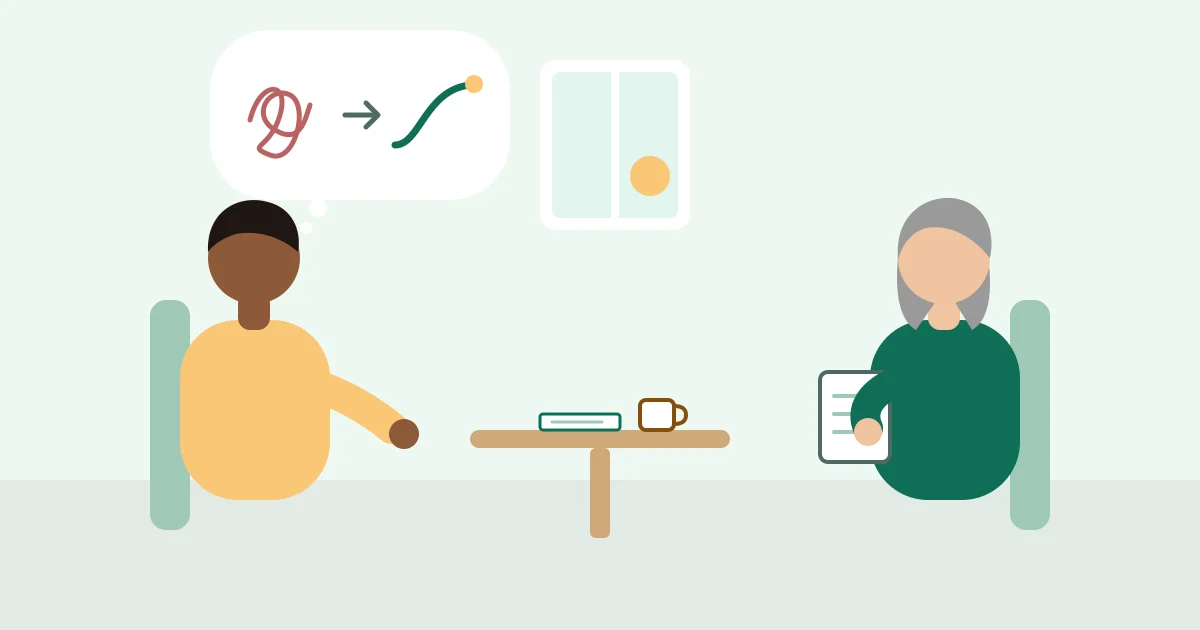
Cognitive behavioral therapy for gambling addiction is a structured, short-term talking therapy. The Division on Addiction at Cambridge Health Alliance calls it one of the most common and well-studied treatments for gambling disorder. This guide explains what happens in sessions, the thinking traps CBT works on, how long it takes and what the research says.
If you or someone you know is thinking about suicide, get help now: call or text 988 in the US, call Samaritans free on 116 123 in the UK and Ireland, or call Lifeline on 13 11 14 in Australia. In an emergency, call 911, 999 or 000.
Key takeaways
- CBT helps you understand what leads you to gamble and change the thoughts and habits behind it.
- In the UK, NICE recommends group CBT as a main treatment for gambling that harms, or one-to-one CBT if a group isn’t right for you.
- A course is usually 6 to 10 sessions. It should include a plan for handling triggers and setbacks.
- A 2023 review found strong evidence that CBT reduces gambling by the end of treatment. Evidence on how long the benefit lasts is weaker.
- CBT can be done one-to-one, in a group, or online.
On this page: What CBT is · What happens in sessions · Thinking traps · How long it takes · Does it work? · Online and group CBT · Other treatments · Finding CBT · FAQ
What is CBT for gambling addiction?
CBT for gambling addiction is a talking therapy that targets the thoughts, situations and habits that lead to gambling. CAMH (the Centre for Addiction and Mental Health, Canada) describes it as intensive, short-term, structured and goal-focused. The Society of Clinical Psychology says it aims to raise awareness of the thoughts and situations that lead to gambling, and to build new ways of thinking and activities that fit your values.
The clinical name for a serious gambling problem is gambling disorder. CBT is used for it in both outpatient and residential programs.
What happens in CBT for gambling?
CBT sessions follow a plan: you and your therapist look at what leads to each bet, then practice ways to break that chain. CAMH lists four main parts: an assessment, a treatment plan with shared goals, thinking and behavior techniques, and a relapse-prevention plan.
- TriggerSomething that sets off the urge, like an ad for betting or a stressful day
- ThoughtA belief that makes betting feel like a good idea, like "I’m due a win"
- FeelingAn urge or craving to gamble
- ActionPlacing a bet, or chasing losses
One CBT program, described in the American Journal of Psychiatry in 2009 and tested in a large trial, ran as 10 weekly one-hour sessions. It included:
- Tracking. Recording gambling and non-gambling days.
- Working out the chain. Mapping the thoughts, feelings and actions that lead up to a bet, and the pros and cons of gambling versus not gambling.
- Managing triggers and urges. Planning ways to cope, such as doing something enjoyable instead or calling a friend when a craving hits.
- Challenging unhelpful thoughts. At least one session on beliefs about luck and chance.
- Saying no. Practicing how to turn down offers to gamble.
- Planning ahead. A final session on future risky situations.
The Division on Addiction adds problem-solving and social skills. NICE says every course should include relapse prevention, such as how to deal with triggers and what to do after a slip.
The thinking traps CBT works on
Some beliefs make gambling feel more winnable than it is. CBT helps you notice them and test them against reality. These examples come from CAMH and the 2009 American Journal of Psychiatry paper:
| Thinking trap | What it sounds like | The reality |
|---|---|---|
| The gambler’s fallacy | “I’ve lost three times on this machine, so I’m due a win” | Each spin, flip or draw is independent: past results don’t change the odds |
| Luck and rituals | “My lucky hat helps me win” | Objects and rituals don’t change the odds |
| Overrating skill | “I know enough about cards or sports to beat the odds” | Chance still plays a big part in every bet |
| Chasing losses | “If I keep playing, I’ll win it back” | Playing longer doesn’t win back what you’ve lost |
The gambler’s fallacy is the mistaken belief that independent events are connected, so a certain result starts to feel “due”, according to EBSCO’s research encyclopedia. A coin has the same chance of landing heads on every flip, however many tails came before.
How long does CBT for gambling take?
A course of CBT for gambling is usually 6 to 10 sessions. NICE says this is typically 8 to 10 sessions in a group or 6 to 8 one-to-one, and that some people need more or fewer. The Society of Clinical Psychology gives an average of about 8 weekly sessions.
| Format | Typical length | Source |
|---|---|---|
| Group CBT | 8 to 10 sessions | NICE (UK) |
| Individual CBT | 6 to 8 sessions | NICE (UK) |
| CBT in general | About 8 weekly sessions | Society of Clinical Psychology (US) |
NICE recommends starting as soon as possible after diagnosis.
How well does CBT work for gambling?
CBT has strong evidence for reducing gambling by the end of treatment. A 2023 umbrella review combined 5 meta-analyses covering 56 studies and 5,389 adults. Compared with little or no treatment, CBT reduced how severe people’s gambling problems were, how often they gambled and how much they gambled. The authors estimate that 65% to 82% of people who have CBT improve more than people who don’t.
The limits matter too:
- Lasting effects are less clear. In the studies that followed people up after treatment, the difference between CBT and no treatment was not statistically significant.
- Research ratings. The Society of Clinical Psychology (part of the American Psychological Association) rated the research support for CBT for gambling disorder as “strong” in 2015.
This is why good CBT includes relapse prevention, and why NICE recommends follow-up and quick re-entry to therapy if needed. Our guide on inpatient vs outpatient treatment covers aftercare in more detail.
One-to-one, group or online?
CBT for gambling can be delivered one-to-one, in a group or online, and CAMH says it works in all of these formats. NICE recommends offering a group first, and one-to-one CBT if a group isn’t possible or suitable.
- Group CBT is NICE’s first choice. It should ideally be run by two practitioners, at least one trained in gambling-specific CBT.
- One-to-one CBT suits people who don’t want a group or when no group is available.
- Online CBT. CAMH says self-directed online CBT with little therapist support can work, and cites research finding internet-based CBT as effective as in person. NICE says remote sessions are more convenient, while in-person ones are more likely to build a strong relationship with the therapist.
- Apps. The Society of Clinical Psychology lists some CBT-based apps but warns that many haven’t been tested.
How CBT fits with other treatments
CBT is often combined with other support. NICE recommends:
- Motivational interviewing for people who are unsure about starting treatment.
- Peer support, such as support groups, as part of treatment for people who want it.
- Naltrexone (a medicine) in some cases, started by a specialist, if CBT hasn’t worked or there have been repeated relapses. In January 2025 this was an off-label use.
The Division on Addiction notes that no medication is approved by the US FDA for gambling disorder, though several are being tested.
How to find CBT for gambling
Look for a therapist or program that offers CBT specifically for gambling. NICE says at least one practitioner should have gambling-specific CBT training.
When we researched 93 gambling treatment programs, 22 named CBT on their own websites, including 12 residential programs and 13 that offer outpatient care. Many others list individual or group therapy without saying which approach they use, so it’s worth asking. Useful questions:
- Do you offer CBT for gambling, and is the therapist trained in it?
- Is it one-to-one, group or online, and how many sessions?
- Does it include a relapse-prevention plan?
Browse outpatient programs or programs that treat gambling only, and read how we check every listing. If you’re supporting someone else, see how to help someone with a gambling problem.
Free gambling helplines
A free helpline can tell you where to find CBT near you. More numbers are on our free help page.
| Country and helpline | Number |
|---|---|
| United States National Problem Gambling Helpline (opens in new tab) Checked November 25, 2026 | 1-800-MY-RESET(1-800-697-3738) Call, text or chat 24/7. Free and confidential. |
| United Kingdom National Gambling Helpline (GamCare) (opens in new tab) Checked November 25, 2026 | 0808 8020 133 24/7, every day of the year. Free. |
| Australia Gambling Helpline (opens in new tab) Checked November 25, 2026 | 1800 858 858 24 hours, 7 days a week. Free and confidential. |
| Thailand Department of Mental Health hotline (opens in new tab) Checked November 25, 2026 | 1323 24 hours. Free. |
| Ireland GamblingCare National Helpline (opens in new tab) Checked November 25, 2026 | 1800 936 725 24/7. Free and confidential. Northern Ireland: 08000 886 725. |
| New Zealand Gambling Helpline (opens in new tab) Checked November 25, 2026 | 0800 654 655 24 hours. Free. |
| Singapore National Problem Gambling Helpline (opens in new tab) Checked November 25, 2026 | 1800-6-668-668 Every day, 8am to 11pm. |
| Hong Kong Ping Wo Fund quit gambling hotline (opens in new tab) Checked November 25, 2026 | 183 4633(then press 1) |
| Netherlands OpenOverGokken helpline (opens in new tab) Checked November 26, 2026 | 0800 24 000 22 24/7. Free. Chat and WhatsApp (+31 6 59818331): 8am to midnight. |
| Norway Hjelpelinjen for spilleavhengige (opens in new tab) Checked November 26, 2026 | 800 800 40 Phone: weekdays, 9am to 6pm. Chat: weekdays, 11am to 3pm. |
| Sweden Stödlinjen (opens in new tab) Checked November 26, 2026 | 020-81 91 00 Monday 9am to 7pm, Tuesday and Wednesday 9am to 5pm, Thursday 11am to 7pm, Friday 9am to 3pm. Free. Swedish or English; Arabic on Thursdays 1pm to 7pm. |
| Belgium SOS Gambling (SOS Gokken / SOS Jeux) (opens in new tab) Checked November 26, 2026 | 0800 35 777 24/7. Free. |
| Germany Check dein Spiel phone counseling (BIÖG) (opens in new tab) Checked November 26, 2026 | 0800 1 37 27 00 Monday to Thursday 10am to 10pm, Friday to Sunday 10am to 6pm. Free from German landlines and mobiles. Anonymous. |
| Austria Spielsuchthilfe (opens in new tab) Checked November 26, 2026 | 01 544 13 57 Free and confidential. |
| Switzerland SOS Spielsucht / SOS Jeu (opens in new tab) Checked November 26, 2026 | 0800 040 080 24/7. Free and anonymous. German and French; an interpreter can be arranged. |
| South Africa NRGP counselling helpline (opens in new tab) Checked November 25, 2026 | 0800 006 008 24 hours. Free and confidential. WhatsApp: 076 675 0710. |
Frequently asked questions
How long does CBT for gambling take?
Usually 6 to 10 sessions. NICE in the UK says a course is usually 8 to 10 group sessions or 6 to 8 individual sessions. The Society of Clinical Psychology gives an average of about 8 weekly sessions. Some people need more sessions, and some need fewer.
Does CBT work for gambling addiction?
Yes, by the end of treatment. A 2023 review of the research found strong evidence that CBT reduces gambling severity and how often people gamble, compared with little or no treatment. Fewer studies followed people up afterward, and in those the difference was smaller and not statistically clear, which is why relapse prevention matters.
Can I do CBT for gambling online?
Yes. CAMH in Canada says CBT for gambling works one-to-one, in groups and as self-directed online programs. NICE says phone or video sessions can be more convenient, while in-person sessions are more likely to build a strong relationship with the therapist. Be careful with apps: the Society of Clinical Psychology notes that many CBT apps haven't been tested.
What is the gambler's fallacy?
The gambler's fallacy is the mistaken belief that past results change the odds of independent events, so a win starts to feel "due" after a run of losses. In reality each spin, flip or draw has the same odds. CBT helps people notice and challenge this kind of thinking.
Is there medication for gambling addiction?
There is no medication approved by the US FDA for gambling disorder, according to the Division on Addiction at Cambridge Health Alliance, though several are being tested. In the UK, NICE says specialists can consider naltrexone if a course of psychological therapy hasn't worked or there have been repeated relapses.
How do I find a therapist who does CBT for gambling?
Ask for a therapist with gambling-specific CBT training: NICE says at least one practitioner should have it. A free gambling helpline can point you to local services, and our directory shows which programs say they offer CBT.
Sources
- Gambling-related harms: identification, assessment and management (NICE guideline NG248, published 28 January 2025) (opens in new tab) (checked November 26, 2026)
- Pfund RA et al. (2023). Cognitive-behavioral treatment for gambling harm: Umbrella review and meta-analysis. Clinical Psychology Review 105:102336 (opens in new tab) (checked November 26, 2026)
- Cognitive-Behavioral Treatment for Gambling Disorder (Society of Clinical Psychology, APA Division 12) (opens in new tab) (checked November 26, 2026)
- Cognitive behavioural therapy (CBT) for problem gambling (CAMH, Canada) (opens in new tab) (checked November 26, 2026)
- Treating Gambling Disorder: A Guide for Providers (Division on Addiction, Cambridge Health Alliance) (opens in new tab) (checked November 26, 2026)
- Okuda M, Balán I, Petry NM, Oquendo M, Blanco C (2009). Cognitive behavioral therapy for pathological gambling: cultural considerations. American Journal of Psychiatry 166(12):1325-1330 (opens in new tab) (checked November 26, 2026)
- Gambler's fallacy (EBSCO Research Starters) (opens in new tab) (checked November 26, 2026)
This guide is general information, not medical advice. See our medical disclaimer. Spotted a mistake? Tell us.